Income property insurance is the protection most Quebec building owners think about least and need most in 2026. It’s easy to treat insurance as a box to check at closing and a bill to pay each year — until a fire, a burst pipe, an ice-related fall, or a liability claim turns it into the only thing standing between you and a catastrophic loss. Owners of multiplexes and heritage buildings in Quebec City face risks a homeowner never encounters, and a policy built for a private home leaves dangerous gaps. Understanding what coverage you actually need, and where owners most often fall short, is one of the highest-value hours you can spend as an investor.
This article is educational, not insurance or financial advice. Coverage rules and products vary; work with a licensed insurance broker and confirm details for your specific building.
Why Landlord Insurance Differs From Home Insurance
The moment a building generates rent, it becomes a business asset — and a standard home policy no longer fits. Insurers price and structure landlord coverage around risks that simply don’t exist in owner-occupied housing.
The differences are significant. A landlord policy contemplates tenants you don’t control, higher liability exposure from people living in and visiting the building, and the financial reality that the property produces income you’d lose if it became uninhabitable. A home policy, by contrast, assumes the owner lives there and carries none of those commercial dimensions. Using the wrong type of policy can leave a claim denied at the worst possible moment.
This is why the first step for any building owner is confirming you hold proper landlord or commercial property coverage suited to your number of units and use. Getting the category right is the foundation everything else builds on.
The Core Coverages Every Quebec Building Owner Needs
A complete policy combines several distinct coverages, and missing any one of them creates real exposure. Think of your protection as a set of layers rather than a single line item.
The essential building blocks typically include:
- Building/property coverage — protection for the structure itself against insured perils like fire and water damage.
- Liability coverage — protection if someone is injured on the property and you’re held responsible.
- Loss of rental income — replacement of the rent you lose if the building becomes uninhabitable after an insured event.
- Equipment and systems — coverage for heating, electrical, and other building systems where applicable.
Each of these addresses a different way a building can cost you money, and a serious investor wants all of them working together. Reviewing your policy against this list with a broker is the simplest way to spot a gap before a claim exposes it.
Insuring Heritage and Older Buildings — The Quebec Challenge
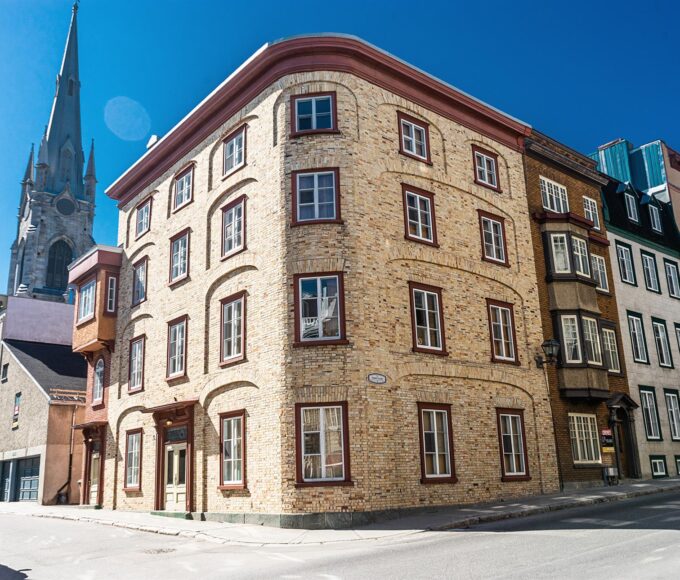
Quebec’s beautiful older and heritage buildings are also the hardest to insure correctly, so they demand extra attention. The very features that give an Old Quebec building its character also make it more expensive and complex to rebuild.
Two issues come up repeatedly. First, replacement cost: rebuilding with period-appropriate masonry, materials, and craftsmanship can cost far more than a generic estimate suggests, and a policy that underestimates this leaves you short. Second, by-law and code considerations: when an older building is damaged, you may be required to rebuild to current codes, which can add substantial cost that only specific coverage addresses. Insuring a heritage building on assumptions meant for new construction is a recipe for a painful surprise.
Owners of older rental buildings should make sure their coverage reflects genuine replacement realities, and pair it with smart upgrades that reduce risk over time. Our guide to the energy retrofit of an older Quebec rental building covers improvements that can both lower operating costs and modernize aging systems that insurers care about.
Loss of Rental Income — The Coverage Owners Forget
If your building can’t be lived in, your rent stops — and loss of rental income coverage is what keeps you afloat. This is the protection owners most often overlook, precisely because it’s invisible until disaster strikes.
Picture a fire or major water event that forces tenants out for months of repairs. The building coverage pays to rebuild, but without loss-of-income coverage, the rent that services your mortgage and covers your expenses simply disappears during that period. For a leveraged investor, that gap can be more financially threatening than the physical damage itself.
When reviewing your policy, confirm not just that this coverage exists but that the amount and duration realistically match how long a serious repair could take on your type of building. On an older structure, that timeline can be longer than you’d expect, which makes adequate coverage all the more important.
Liability — Your Biggest Hidden Exposure
Liability is where a single incident can generate a claim larger than the building itself, so never treat it as an afterthought. As a building owner, you carry responsibility for the safety of the people in and around your property.
Quebec’s climate sharpens this exposure. Slip-and-fall incidents on icy walkways and stairs are a real and recurring winter risk, and an owner can be held responsible for failing to maintain safe conditions. Beyond weather, there’s exposure from building conditions, injuries inside units, and common-area hazards. Adequate liability limits — and diligent maintenance to prevent incidents in the first place — work together to protect you.
This is also where your ownership structure interacts with your insurance. Some investors hold buildings through a corporation partly for liability separation, a topic we explore in our piece on buying real estate through a corporation in Quebec. Insurance and structure are complementary protections, not substitutes for each other.
Requiring Tenant Insurance — A Smart Layer of Protection
Your policy protects the building, not your tenants’ belongings — so requiring tenant insurance closes a real gap. A tenant’s own contents and personal liability are their responsibility, and confirming they’re covered protects everyone.
When a tenant lacks insurance and suffers a loss, the situation can become messy and may invite disputes that drift toward you. Many owners now include a lease requirement that tenants carry their own insurance, which reduces friction after an incident and reinforces a professional, well-run building. It’s a low-cost layer that benefits both sides.
Implementing this is simply a matter of building the requirement into your lease process and confirming compliance. It signals that you run the property seriously and helps ensure that when something goes wrong, the right coverage responds.
How to Avoid Being Underinsured
Underinsurance is the quiet trap that turns a covered loss into a financial blow, so guard against it actively. Far too many owners discover only at claim time that their coverage falls short of what rebuilding actually costs.
To stay properly protected:
- Understand replacement cost versus actual cash value, and know which basis your policy uses.
- Reappraise periodically, since construction costs and property values change and a policy set years ago may be outdated.
- Document the building thoroughly — photos, systems, upgrades, and improvements — so a claim is easier to substantiate.
- Review coverage after any renovation, because improvements can raise the replacement cost your policy needs to reflect.
- Work with a licensed broker who understands Quebec income properties and can match coverage to your real exposure.
Quebec’s insurance sector is overseen by the Autorité des marchés financiers (AMF), and a qualified broker can help you confirm your protection is both compliant and adequate. Treating insurance as an annual strategic review rather than a renewal you rubber-stamp is what separates owners who weather a disaster from those who are financially leveled by one.